

WISMO stands for Where Is My Order. Those calls and emails customers send asking about a shipment after they’ve already placed it.
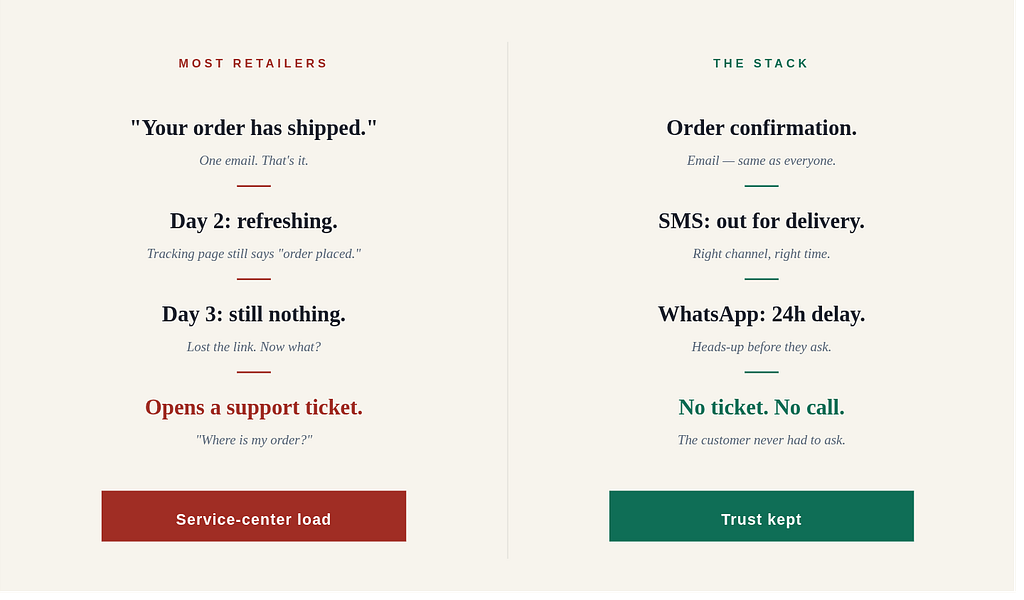
Most retailers don’t actually have a strategy for WISMO. They send one email when the order ships, and then they go quiet. The customer is left checking their inbox and refreshing the courier page. After three days of nothing, they email support: “Where is my order?”
And most retailers think they’ve solved it. Add a tracking link to the email. Maybe a branded tracking page. Done.
It’s not done. It’s a service-center nightmare. Every WISMO email is a customer who stopped trusting your fulfillment somewhere between checkout and delivery. That costs you agent hours, it costs you the next order, and it slowly costs you the brand.
The fix isn’t a better tracking page. The actual fix is keeping the customer informed at every stage, through whichever channel they prefer: email, SMS, WhatsApp, LINE. A better tracking page is one cog in that system, not the whole system.
A sale closed is a sale done. A good after-sales service is the next sale coming.
If you are building on Salesforce, OMS, Marketing Cloud, and Agentforce can solve WISMO at the root and take real load off your service center. Here’s how.
- OMS is the source of truth. It pulls real fulfillment status from your WMS, 3PL, and last-mile delivery partners into one place.
- Marketing Cloud is the informer. It proactively pushes that status to the customer at every stage, on the channel they actually use.
- Agentforce is the guide. When a customer still wants to check, it answers them instantly without involving a human.
OMS: The Source of Truth
Without OMS, your systems don’t talk to each other. Each one holds a piece of the order, and none of them knows what the others know.
Salesforce OMS sits between your storefront and the systems that actually move the parcel. WMS knows what’s on the shelf. The 3PL knows when it left the warehouse. Last-mile delivery knows where the courier is right now. None of them is talking to each other, and the customer gets the worst view of all.
OMS unifies that. It pulls events from every system, turns them into one timeline, and makes that timeline available to everyone who needs it. Order placed, picked, packed, handed to courier, in transit, out for delivery, delivered.
Once the systems are speaking through OMS, the rest of the stack can trust what it sees. Marketing Cloud knows when to send what. Service Cloud knows what the agent should see. Agentforce has something real to answer with.
No unified communication, no system. Just four products telling the customer four different stories.
Marketing Cloud: The Informer
OMS knows where the order is. Marketing Cloud’s job is to make sure the customer knows too, on the channel they actually use.
Because without proactive updates, the frustration is real. You send an email saying the order has shipped, with a tracking link. The customer opens the link. It shows “order placed.” Then nothing. Three days of nothing. Some customers will check the link again. Some will lose it. Most will just open a support ticket.
And the channel matters as much as the message. If your customer rarely opens emails, an email notification is as worthless as no notification. Right info, right channel, right time, that’s the bar.
Marketing Cloud lets you build that. Email for the order confirmation. SMS when the parcel is out for delivery. WhatsApp or LINE when there’s a delay the customer needs to act on. Each stage on the channel that the customer responds to.
And once the journey is built, you can layer it. High-value customers get a heads-up 24 hours before a delay. First-time buyers get extra reassurance. Loyalty members get expedited remediation if something goes wrong.
Same data, different treatment. That’s what an informer layer does.
Agentforce: The Guide
Logged-in customers can usually find their order on their own. They go to “My Orders,” check the status, and move on. No support ticket needed.
But what about guest checkouts? They have no account to log into, no order page to refresh. The only way they can check on their order is to ask. And until now, asking meant either hunting through your help center or waiting for a human to respond.
Agentforce changes that. The customer chats, types “where is my order,” and Agentforce takes over. It pulls the latest status from OMS, explains what the status means, and surfaces the next best action — track the parcel, contact the courier, or request a reshipment.
No queue. No “your call is important to us.” No agent reading the same screen the customer just refreshed.
The customers who really need a human still get one for the genuine exceptions, the lost parcels, the disputed deliveries. But the routine WISMO load, especially from guest checkouts, is handled by an agent that already knows the answer.
Source of truth, informer, guide. Three layers, one job: stop making the customer ask.
This is just a high-level view of how the three layers fit together. The real work sits in the integration patterns, the event design, the channel orchestration, the fallback behaviours when one system goes silent. Each layer has its own depth, and stitching them together cleanly is where most implementations either succeed or quietly fail.
If you’re working on this in your own stack, I’d love to compare notes. Highlight the layer you find hardest to implement, or drop a response below to talk architecture.